ml19539 1

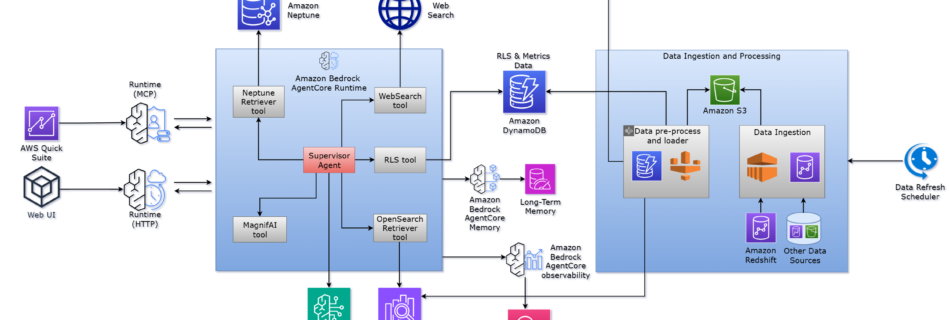
Running deep research AI agents on Amazon Bedrock AgentCore

AI agents are evolving beyond basic single-task helpers into more powerful systems that can plan, critique, and collaborate with other agents to solve complex problems. Deep Agents—a recently introduced framework built on LangGraph—bring these capabilities to life, enabling multi-agent workflows that mirror real-world team dynamics. The challenge, however, is not just building such agents but …

image3 99Is5bhmax 1000x1000 1

AI Innovators: How JAX on TPU is helping Escalante advance AI-driven protein design

As a Python library for accelerator-oriented array computation and program transformation, JAX is widely recognized for its power in training large-scale AI models. But its core design as a system for composable function transformations unlocks its potential in a much broader scientific landscape. Following our recent post on solving high-order partial differential equations, or PDEs, …

Qwen-Image-Edit-2509 has been released

This September, we are pleased to introduce Qwen-Image-Edit-2509, the monthly iteration of Qwen-Image-Edit. To experience the latest model, please visit Qwen Chat and select the “Image Editing” feature. Compared with Qwen-Image-Edit released in August, the main improvements of Qwen-Image-Edit-2509 include: Multi-image Editing Support: For multi-image inputs, Qwen-Image-Edit-2509 builds upon the Qwen-Image-Edit architecture and is further …

122EDwImi4b5D3tZuY8KXjQ

Scaling Muse: How Netflix Powers Data-Driven Creative Insights at Trillion-Row Scale

By Andrew Pierce, Chris Thrailkill, Victor Chiapaikeo At Netflix, we prioritize getting timely data and insights into the hands of the people who can act on them. One of our key internal applications for this purpose is Muse. Muse’s ultimate goal is to help Netflix members discover content they’ll love by ensuring our promotional media …

ML 19059 1

Rapid ML experimentation for enterprises with Amazon SageMaker AI and Comet

This post was written with Sarah Ostermeier from Comet. As enterprise organizations scale their machine learning (ML) initiatives from proof of concept to production, the complexity of managing experiments, tracking model lineage, and managing reproducibility grows exponentially. This is primarily because data scientists and ML engineers constantly explore different combinations of hyperparameters, model architectures, and …