The White House Is Starting to Panic Over the Midterms
President Donald Trump still thinks Republicans have a shot. His aides are less convinced.
President Donald Trump still thinks Republicans have a shot. His aides are less convinced.
In the production of video games and animated movies, directors and animators are constantly fine-tuning how a character’s movements should appear. In many cases, directors require subtle changes, such as making a character appear a little more restrained or a bit more expressive, and communicate subjectively how much change is needed.
submitted by /u/Philosopher115 [link] [comments]
In this article, you will learn how to automatically extract structured knowledge from raw text and populate a knowledge graph with SPOC quads using a…
When language models reason in chain-of-thought or exchange free-text intermediates, they serialize structured information into natural language. How much tree-structured compositional content survives this bottleneck? We propose a round-trip protocol that answers this question empirically for tree-structured expressions. A generator converts a procedurally generated arithmetic expression into a word problem, a separate extractor recovers the …
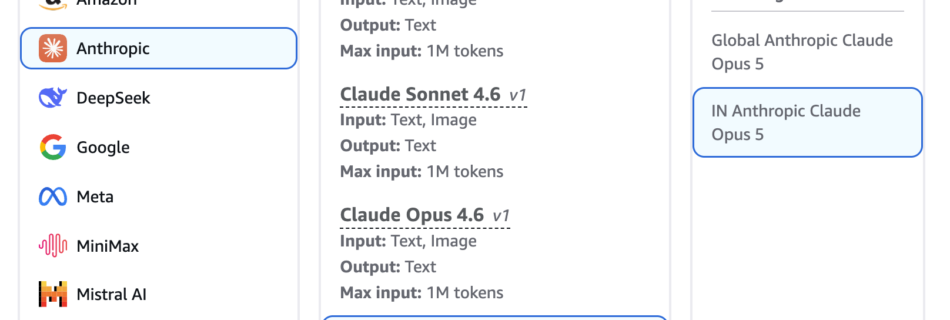
We’re excited to announce the availability of Anthropic’s Claude Opus 5, Claude Sonnet 5, and Claude Haiku 4.5 in India. The India regional endpoint is served through geographic cross-Region inference. Customers in India can now access these models on Amazon Bedrock while processing the data in the India Regions in addition to the already supported …
Read more “Amazon Bedrock expands Claude model availability to in-country inferencing in India”
By sharing the same platform, the Sport gets the same specs as the classier Range Rover Electric, but with added torque at a smaller outlay.
OpenAI CEO Sam Altman introduced a “remarkably capable, always-on” artificial intelligence agent at an appearance Tuesday where he avoided any reference to security concerns around the company’s most advanced models.
Hey all, vlo is open source video editing and generation software. It is designed for interactivity between generative AI and the timeline, so you can inpaint anywhere on the timeline, extract frames and videos to use as references, use SAM2 for video masking and sam-audio for stem extraction etc. It comes with built-in workflows for …
In this article, you will learn how to build a fully local, zero-cost agentic AI workflow using Hermes Agent and Ollama, so that your files,…