Gemini Robotics 1.5 brings AI agents into the physical world
New era of physical agents will help robots perceive, plan, think, use tools and act to solve complex tasks.
New era of physical agents will help robots perceive, plan, think, use tools and act to solve complex tasks.
Self-supervised learning (SSL) has made significant advances in speech representation learning. Models like wav2vec 2.0 and HuBERT have achieved state-of-the-art results in tasks such as speech recognition, particularly in monolingual settings. However, multilingual SSL models tend to underperform their monolingual counterparts on each individual language, especially in multilingual scenarios with few languages such as the …

Building for Tomorrow Introduction Palantir’s customers use our software platforms for their most critical challenges — from delivering vaccines to enabling force readiness to building resilient supply chains — and these challenges often require bringing together data with unique sensitivities from a variety of source systems. This is why we have spent the past 20-plus years building tools for security, …
Read more “How Palantir’s Strategic Privacy Investments Enable Future Customer Success”
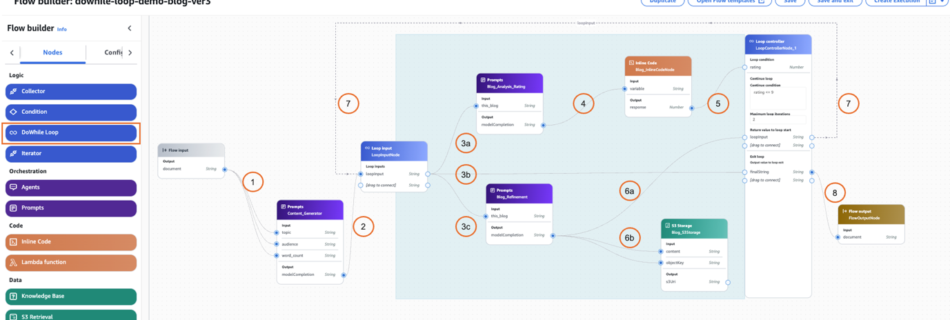
Today, we are excited to announce support for DoWhile loops in Amazon Bedrock Flows. With this powerful new capability, you can create iterative, condition-based workflows directly within your Amazon Bedrock flows, using Prompt nodes, AWS Lambda functions, Amazon Bedrock Agents, Amazon Bedrock Flows inline code, Amazon Bedrock Knowledge Bases, Amazon Simple Storage Service (Amazon S3), …
Read more “DoWhile loops now supported in Amazon Bedrock Flows”

Innovating with AI requires accelerators such as GPUs that can be hard to come by in times of extreme demand. To address this challenge, we offer Dynamic Workload Scheduler (DWS), a service that optimizes access to compute resources when and where you need them. In July, we announced Calendar mode in DWS to provide short-term …
Read more “GPUs when you need them: Introducing Flex-start VMs”
Following the 15 Ultra, the new Xiaomi 17 Pro Max sounds and looks very familiar to a certain iPhone, but with a twist.
Caltech scientists have built a record-breaking array of 6,100 neutral-atom qubits, a critical step toward powerful error-corrected quantum computers. The qubits maintained long-lasting superposition and exceptional accuracy, even while being moved within the array. This balance of scale and stability points toward the next milestone: linking qubits through entanglement to unlock true quantum computation.
At a time when conflict and division dominate the headlines, a new study from UCLA finds remarkable similarities in how mice and artificial intelligence systems each develop cooperation: working together toward shared goals.
submitted by /u/-Ellary- [link] [comments]