Adding Temporal Reasoning to Graph-RAG: Tracking Fact Freshness and Staleness
In this article, you will learn how to add a lightweight temporal reasoning layer to a Graph-RAG system so that it can distinguish fresh facts…
In this article, you will learn how to add a lightweight temporal reasoning layer to a Graph-RAG system so that it can distinguish fresh facts…
Chain Visualization: Reading the Trace Waterfall The spans from the last section don’t mean much as a raw list.
Recent autonomous machine learning engineering (MLE) agents have made significant progress on public leaderboards. Often motivated by progress stagnation over long-horizon cycles and limited Large Language Model (LLM) primitives, modern MLE agents are deployed on top of increasingly elaborate machinery: multi-agent orchestrators, dedicated retrieval subagents, and more. While such harnesses expand, the use of more …
Read more “How Much of a Harness Does a Strong Agent Need for Autonomous ML Engineering?”
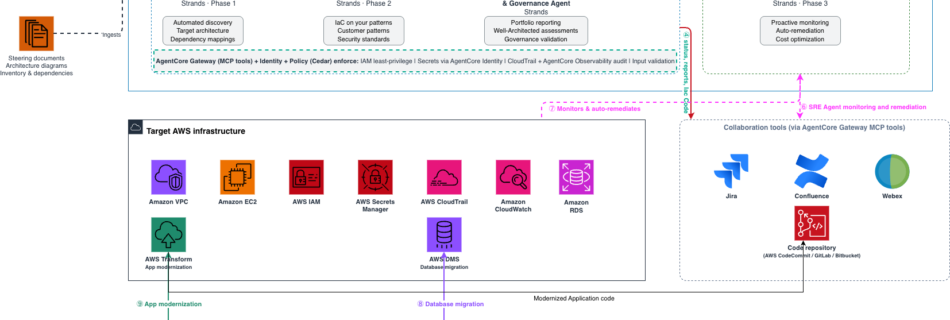
October 2026: This post was reviewed and updated for accuracy. Scaling cloud migrations with agentic AI on Amazon Bedrock AgentCore raises a practical question. Which parts of a large migration program belong to a managed service, and which parts need custom automation? One enterprise program answered that question across 300+ applications and a fixed fiscal …
Read more “Scaling cloud migrations with agentic AI on Amazon Bedrock AgentCore”
Asking AI companies to self-regulate is a great way to pretend like you’ve accomplished something.
A proposed qubit made with superfluid helium could cut quantum computing error rates by around 100 times by shielding quantum information from common forms of electromagnetic noise. If experiments confirm the predictions, the technology could eventually work alongside today’s superconducting qubits or serve as a new kind of quantum memory.
Let’s say you ask ChatGPT a question that stumps it, or a Waymo vehicle encounters something unusual in the road, or an autonomous factory faces an unexpected disruption. Most people would recognize that something unexpected has happened and adjust accordingly. For machines, it’s not always that simple.
submitted by /u/NewEconomy55 [link] [comments]
Controlling the output of Large Language Models (LLMs) is a central challenge for their reliable deployment, yet a clear understanding of the involved trade-offs remains elusive. Current approaches to conditioning are often evaluated with a narrow focus on their effectiveness at injecting or removing a target concept, neglecting generation quality. We systematically investigate a range …
Read more “On the Effectiveness-Fluency Trade-Off in LLM Conditioning: A Systematic Study”
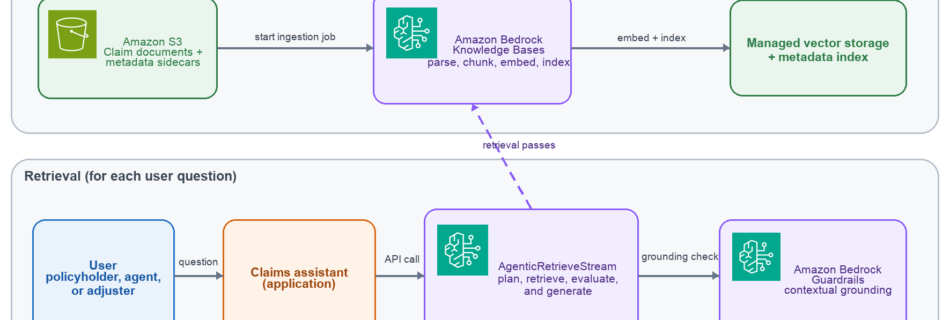
Claim answers are scattered across adjuster diary entries, repair estimates, police reports, payment ledgers, and scanned attachments rather than one searchable field. A policyholder might ask whether a claim was approved, while an adjuster might need every open auto claim over $10,000 from last month. Both tasks require finding and combining evidence quickly and accurately. …
Read more “Query claims in natural language with Amazon Bedrock Knowledge Bases”