Google’s new AI algorithm reduces memory 6x and increases speed 8x
https://arstechnica.com/ai/2026/03/google-says-new-turboquant-compression-can-lower-ai-memory-usage-without-sacrificing-quality/ submitted by /u/pheonis2 [link] [comments]
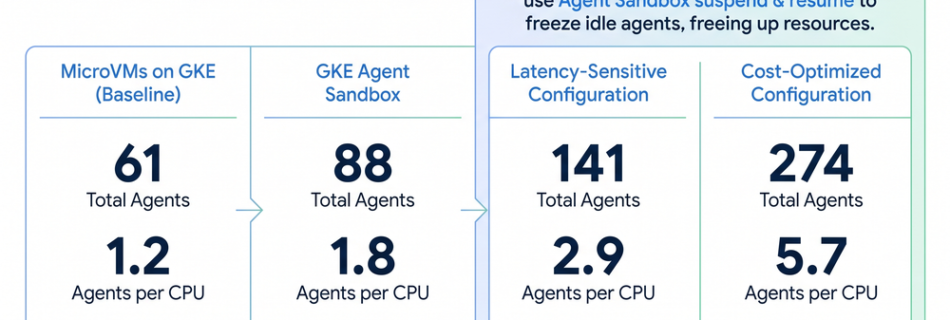
Creating an AI agent for tasks like analyzing and processing documents autonomously used to require hours of near-endless configuration, code orchestration, and deployment battles.
State Space Models (SSMs) have become the leading alternative to Transformers for sequence modeling. Their primary advantage is efficiency in long-context and long-form generation, enabled by fixed-size memory and linear scaling of computational complexity. We begin this work by showing a simple theoretical result stating that SSMs cannot accurately solve any “truly long-form” generation problem …
Read more “To Infinity and Beyond: Tool-Use Unlocks Length Generalization in State Space Models”
As developers build AI agents with more sophisticated reasoning systems, they require higher-quality fuel–in the form of enterprise data and specialized tools–to drive real business value. To get the most out of that octane-rich mix, we offer Google-managed model context protocol (MCP) servers: an engine purpose-built for AI agents to interact securely with Google and …
Read more “How to build production-ready AI agents with Google-managed MCP servers”
A policy change announced by NeurIPS, the world’s leading AI research conference, drew widespread backlash from Chinese researchers this week and then was quickly reversed.
The human brain constantly makes decisions. It requires minimal power to move bodies in a desired direction or avoid an object. A Purdue University engineer uses the brain’s efficiency as inspiration to help autonomous vehicles, such as drones and robots, make crucial, time-sensitive decisions while operating in the field.
I created a completely local Ethot online as an experiment. I dream of a world that all ethots are all made on computers so easily that they have no value anymore. So instead people put down their phones and go outside. So in an effort to make that world real, I’m sharing the tools with …
Traditional databases answer a well-defined question: does the record matching these criteria exist?
Despite their output being ultimately consumed by human viewers, 3D Gaussian Splatting (3DGS) methods often rely on ad-hoc combinations of pixel-level losses, resulting in blurry renderings. To address this, we systematically explore perceptual optimization strategies for 3DGS by searching over a diverse set of distortion losses. We conduct the first-of-its-kind large-scale human subjective study on …
Read more “Drop-In Perceptual Optimization for 3D Gaussian Splatting”
How we built lightweight, real-time map collaboration for teams operating at the edge. About This Series Frontend engineering at Palantir goes far beyond building standard web apps. Our engineers design interfaces for mission-critical decision-making, build operational applications that translate insight to action, and create systems that handle massive datasets — thinking not just about what the user needs, but …
Read more “Frontend Engineering at Palantir: Redefining Real-Time Map Collaboration”