Evaluating Graph-RAG vs. Standard RAG: A Hallucination Benchmark on Fact-Dense Queries
In this article, you will learn how to benchmark a deterministic 3-Tiered Graph-RAG system against a standard vector RAG pipeline on fact-dense queries, and what…
In this article, you will learn how to benchmark a deterministic 3-Tiered Graph-RAG system against a standard vector RAG pipeline on fact-dense queries, and what…
Diffusion-based models decompose sampling into many small Gaussian denoising steps, an assumption that breaks down when generation is compressed to a few coarse transitions. Existing few-step methods address this through distillation, consistency training, or adversarial objectives, but sacrifice the likelihood framework in the process. We introduce Normalizing Trajectory Models (NTM), which models each reverse step …
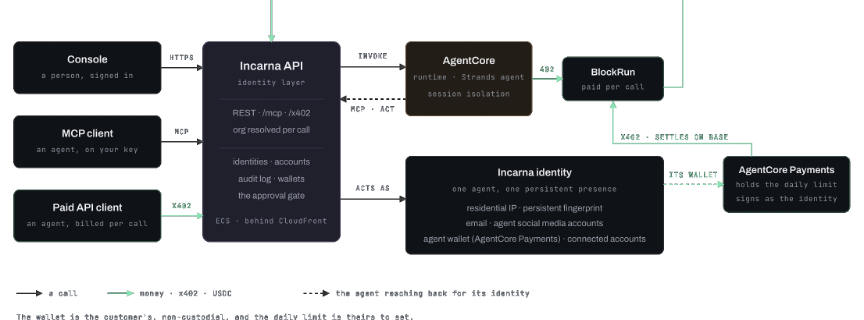
When an AI agent runs, it often needs to buy something to finish a task: a model inference, an API response, access web content, or a call to another agent. These purchases are small and frequent, sometimes a fraction of a cent each, and they happen inside the agent’s loop with no person available to …
In recent decades, Ireland has grown into a vibrant hub for global technology. As modernization accelerates, Irish organizations — spanning government agencies, established enterprise brands, and growing startups in AI and other areas — are all advancing their technical foundations. Today, leaders across the country are injecting agentic AI into every layer of their business …
Read more “Innovation in Ireland: How Irish brands scale with Gemini Enterprise”
Documents obtained by Democracy Forward show that ICE looked into feeding voter roll data into the ELITE tool, normally used to identify targets for deportation.
Most of us now carry in our pockets devices capable of running small AI chatbots. These chatbots have little safety oversight to ensure they don’t provide information and answers with the potential to encourage self-harm, lead to financial loss or promote extremist notions—especially when operating offline.
Since i saw a post for native support in comfyui for Hunyuan image 3 i got really exited to try it out locally. On Strix Halo (Ryzen ai max 395+) i’m getting around 300 seconds per generation while on rtx 3090 it gets around 60 to 70 seconds for 1 megapixel (crashes if i go …
In this article, you will learn how to choose the right agentic AI framework for your production system by working through a structured decision-tree based…
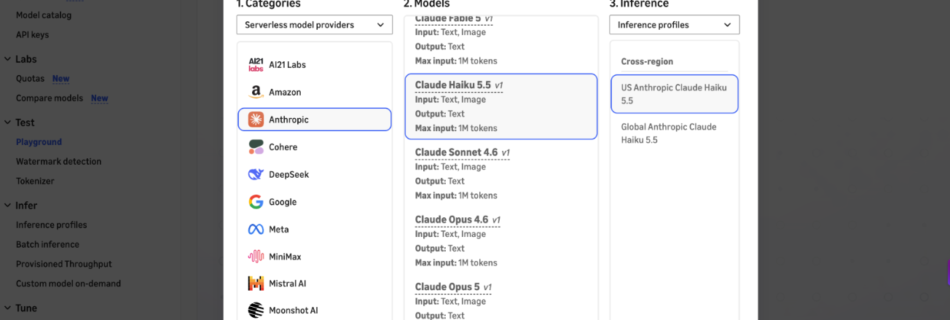
Today, we’re excited to announce the availability of Claude Haiku 5.5 on Amazon Bedrock and Claude Platform on AWS. According to Anthropic, Claude Haiku 5.5 is the fastest and most efficient model in the Claude 5.5 family, built for subagents and high-volume, cost-sensitive work. It also costs around 75 percent less than Claude Haiku 4.5 …
Amazon Prime Big Deal Days are here, and we’ve tracked down the best discounts on all the gear our team recommends.