02Axt810Eph erxVjWM

Ensuring Compliance in Chatbot Deployment for Regulated Industries

Chatbots are rapidly growing in popularity across a spectrum of sectors thanks to their convenience in handling basic customer service needs, such as answering questions. In fact, approximately 67% of consumers have utilized chatbots for quick interactions, with 86% reporting positive experiences​ using them. However, deploying chatbots in heavily regulated sectors such as finance, healthcare, and …

12Ajv2kg3o8zMbv4kKKcuA9CA

Human Rights and Technology

Palantir’s Privacy-First Engineering Approach Introduction Palantir is a mission-driven company, and this mission orientation is reflected in the institutions we support, the products we develop, and the internal culture we foster. Our commitment to privacy engineering has been a cornerstone of our operations for the past 20 years. From addressing the challenges faced by our …

12Am lKjIe460GlWr5JseoQzw

Improve Your Next Experiment by Learning Better Proxy Metrics From Past Experiments

By Aurélien Bibaut, Winston Chou, Simon Ejdemyr, and Nathan Kallus We are excited to share our work on how to learn good proxy metrics from historical experiments at KDD 2024. This work addresses a fundamental question for technology companies and academic researchers alike: how do we establish that a treatment that improves short-term (statistically sensitive) outcomes …

ML 16331 LLMGuardrailsPipeline

Secure RAG applications using prompt engineering on Amazon Bedrock

The proliferation of large language models (LLMs) in enterprise IT environments presents new challenges and opportunities in security, responsible artificial intelligence (AI), privacy, and prompt engineering. The risks associated with LLM use, such as biased outputs, privacy breaches, and security vulnerabilities, must be mitigated. To address these challenges, organizations must proactively ensure that their use …

image2 WkreOee

A multimodal search solution using NLP, BigQuery and embeddings

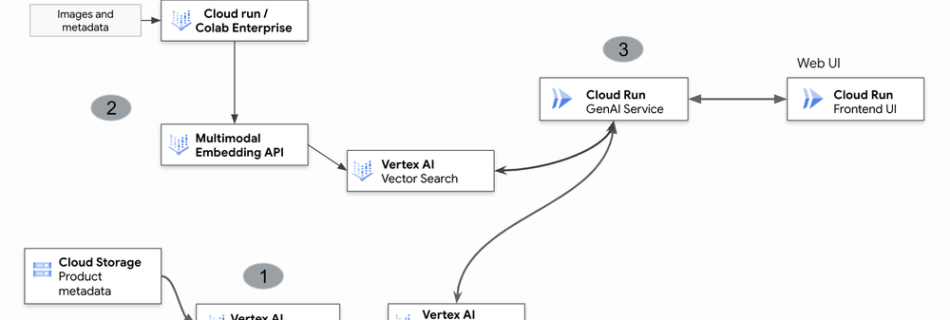
Today’s digital landscape offers a vast sea of information, encompassing not only text, but also images and videos. Traditional enterprise search engines were primarily designed for text-based queries, and often fall short when it comes to analyzing visual content. However, with a combination of natural language processing (NLP) and multimodal embeddings, a new era of …

Blog.drawio.max 1000x1000 1

Choosing between self-hosted GKE and managed Vertex AI to host AI models

In today’s technology landscape, building or modernizing applications demands a clear understanding of your business goals and use cases. This insight is crucial for leveraging emerging tools effectively, especially generative AI foundation models such as large language models (LLMs). LLMs offer significant competitive advantages, but implementing them successfully hinges on a thorough grasp of your …

12ASDjwCtEiANmDXts99VmLPg

LLMs for Chatbots and Conversational AI: Building Engaging User Experiences

Large Language Models have emerged as the central component of modern chatbots and conversational AI in the fast-paced world of technology. Just imagine conversing with a machine that is as intelligent as a human. The use cases of LLM for chatbots and LLM for conversational AI can be seen across all industries like FinTech, eCommerce, healthcare, …

Positional Description for Numerical Normalization

We present a Positional Description Scheme (PDS) tailored for digit sequences, integrating placeholder value information for each digit. Given the structural limitations of subword tokenization algorithms, language models encounter critical Text Normalization (TN) challenges when handling numerical tasks. Our schema addresses this challenge through straightforward pre-processing, preserving the model architecture while significantly simplifying number normalization, …

1 Infrastructure decisions Which GPU sh.max 1000x1000 1

Maximize your LLM serving throughput for GPUs on GKE — a practical guide

Let’s face it: Serving AI foundation models such as large language models (LLMs) can be expensive. Between the need for hardware accelerators to achieve lower latency and the fact that these accelerators are typically not efficiently utilized, organizations need an AI platform that can serve LLMs at scale while minimizing the cost per token. Through …