Why AI Doesn’t Need Your Content — And What It Actually Needs Instead
Ask most people what makes content valuable to AI right now, and you’ll get some version of the same answer: write more, write well, write… Continue reading on Chatbots Life »
Category Added in a WPeMatico Campaign
Ask most people what makes content valuable to AI right now, and you’ll get some version of the same answer: write more, write well, write… Continue reading on Chatbots Life »
Unified multimodal models that understand, reason over, and generate interleaved text–image sequences remain structurally fragmented: existing approaches either sacrifice visual fidelity through discrete tokenization, impose structural asymmetry by combining causal text generation with iterative diffusion-based denoising, or degrade pretrained understanding when adapting vision-language models for generation. We observe that autoregressive normalizing flows are autoregressive Transformers—sharing …
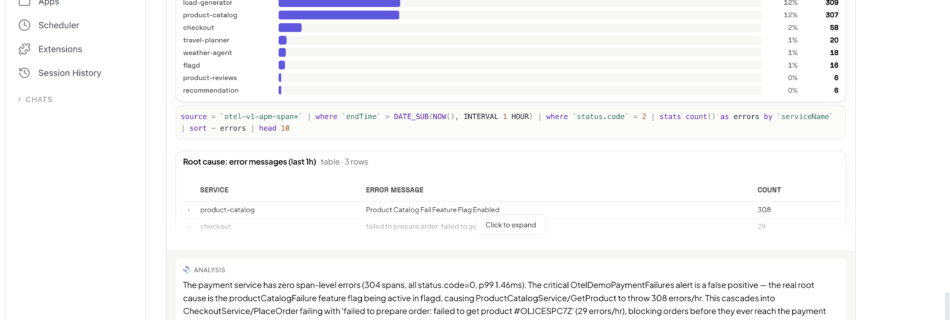
Observability agents are fast. They query alerts, correlate logs with traces, and produce a root cause hypothesis in minutes. The part that still takes time is verification. You read the agent’s text summary, open your observability tools in a browser, navigate to the trace waterfall, check the service map to scope impact, and cross-reference what …
Read more “Agentic observability with Amazon OpenSearch Service MCP Apps”
Few professions are as exacting as the practice of law. A team reviewing a contract or building a case works inside strictly privileged information, firm-specific playbooks, and a body of law that changes constantly. The work thrives on nuanced, professional judgment — and the systems supporting it inherit real obligations: ethical walls that cannot be …
Multimodal large language models increasingly use visual chain-of-thought (Visual CoT) to reason about spatial, temporal, and embodied environments. By generating intermediate reasoning images, Visual CoT provides an intuitive mechanism for visual foresight but introduces substantial inference overhead, which is particularly problematic for proactive video reasoning. We ask whether models can learn to think visually during …
Read more “Beyond Visual CoT: Internalized Visual Thinking for Proactive Video Reasoning”
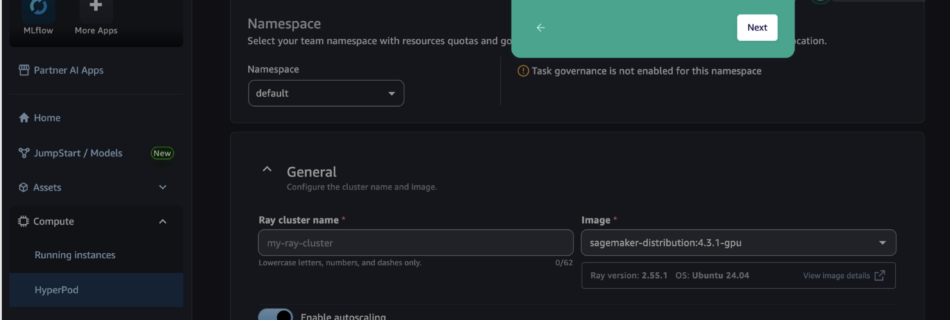
Today, we are announcing new Ray capabilities on Amazon SageMaker HyperPod that integrate Ray with the HyperPod purpose-built infrastructure for foundation model training and serving. Ray is an open-source framework that data scientists use to scale distributed Python workloads across clusters of GPUs, from distributed training with Ray Train to model serving with Ray Serve. …
Read more “Introducing new Ray capabilities on SageMaker HyperPod”
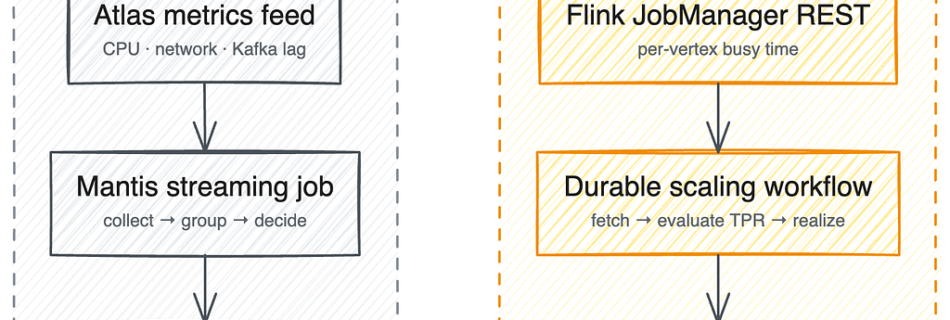
Samuel Yeboah, Francesco Di Chiara and Mingliang Liu Today, Netflix runs two Flink autoscalers. That is exactly one more than we want. We built the first one in-house years ago, when there was no mature option suited to our platform. The second came from the Apache Flink community, and it can scale workloads our homegrown …
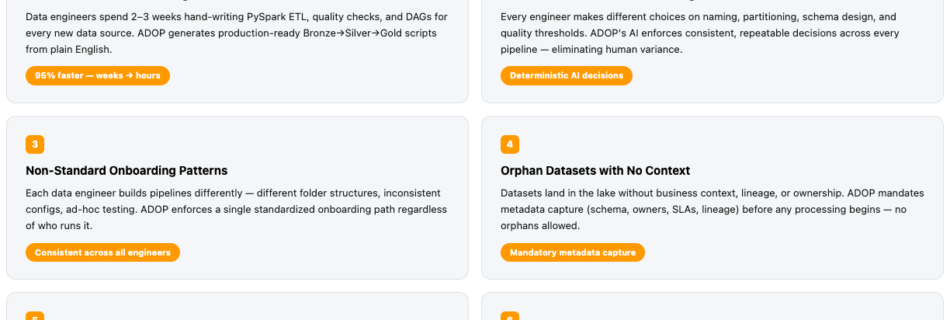
Data engineering teams routinely spend weeks standing up a single new data source: writing ETL, hand-writing quality checks, updating semantic models, and validating compliance. The Agentic Data Operations Platform (ADOP) on AWS is designed to significantly accelerate that timeline. It’s a reference architecture built on Amazon Bedrock and your AI coding tool of choice. Specialized …
Read more “Agentic Data Operations Platform (ADOP): Data engineering into hours”

Welcome to the first Cloud CISO Perspectives for August 2026. Today, Chris Betz explains why the AI era makes it more important than ever to lean into security fundamentals. As with all Cloud CISO Perspectives, the contents of this newsletter are posted to the Google Cloud blog. If you’re reading this on the website and …
Read more “Cloud CISO Perspectives: Sticking to security fundamentals in the AI era”
Cross-lingual knowledge transfer is critical for building high-performing multilingual language models for languages with insufficient training data. When target language data is scarce, the knowledge required for many downstream tasks involving scientific reasoning, commonsense inference, and world knowledge must be acquired primarily from the high-resource language, making effective knowledge transfer essential. Existing methods for improving …
Read more “Multilingual Knowledge Transfer under Data Constraints via Lexical Interventions”