ML 19433 1

Beyond RAG: Task-aware knowledge compression for enterprise AI on AWS

If you’re using Retrieval-Augmented Generation (RAG) for complex analytical tasks that span hundreds of documents, such as financial due diligence or regulatory compliance reviews, you’ve likely hit its ceiling. Similarity search surfaces relevant fragments but often misses cross-document connections. This post shows you how to address that gap using task-aware knowledge compression (TAKC), a technique …

LEAD: Breaking the No-Recovery Bottleneck in Long-Horizon Reasoning

Long-horizon execution in Large Language Models (LLMs) remains unstable even when high-level strategies are provided. Evaluating on controlled algorithmic puzzles, we demonstrate that while decomposition is essential for stability, extreme decomposition creates a “no-recovery bottleneck”. We show that this bottleneck becomes critical due to highly non-uniform error distribution, where consistent errors on a few “hard” …

ML 21458 1

Introducing Claude Opus 5 on AWS: Anthropic’s most capable Opus model

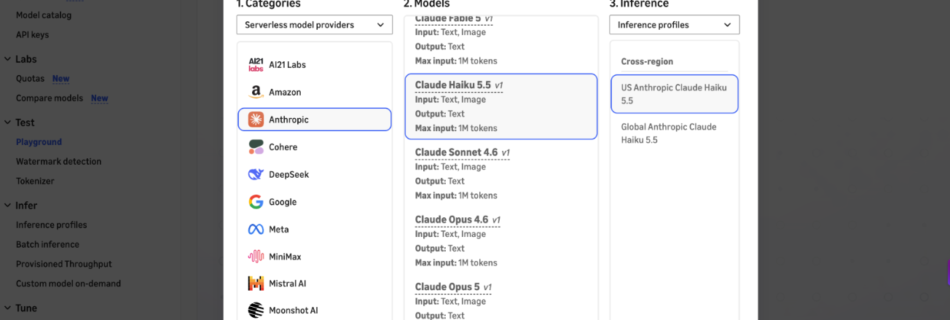
Today, we announce the availability of Claude Opus 5 on Amazon Bedrock and Claude Platform on AWS. Claude Opus 5 is Anthropic’s most advanced Opus model and the first in the fifth generation. It is a meaningful step forward, providing improvements across the workflows that teams run in production such as agentic coding, knowledge work, …

ML 21149 1

Best practices for applying Amazon Bedrock Guardrails to code generation workflows

This post continues our series on best practices with Amazon Bedrock Guardrails. For the previous post, see Build safe generative AI applications like a pro: best practices with Amazon Bedrock Guardrails. AI-powered coding assistants and code generation workflows, such as Claude Code, Kiro, and OpenAI Codex, are transforming how developers write software. These tools generate …

image1 DsM3Zprmax 1000x1000 1

The Blueprint: How Voicify makes AI-enabled ordering a delight for customers

Welcome to The Blueprint, a new feature where we highlight how Google Cloud customers are tackling unique and common challenges across industries using the latest AI and cloud technologies. We hope to inspire others looking to innovate in their work. Founded in 2018, Voicify reimagines the traditional phone call with the goal of transforming every …

ML 21226 1

AI Teammates: how monday.com runs production AI agents on Amazon Bedrock

AI Teammates are agentic AI on Amazon Bedrock, and few engineering organizations run them in production at the scale that monday.com does. Nine in ten Builders use AI coding tools every month, up from roughly half a year ago. Per-engineer PR throughput is up by more than half. Every figure in this post comes from …

Environment-free Synthetic Data Generation for API-Calling Agents

Training API-calling large language model (LLM) agents demands massive amounts of high-quality trajectories. However, collecting such data at scale typically requires fully implemented environments with executable APIs and realistic, pre-populated backend databases, creating a major bottleneck for scalability. To overcome this, we propose an environment-free synthetic data generation approach that leverages LLMs as on-the-fly digital …

ML 20897 1 1 1

Exploring self-distilled reasoning for supervised fine-tuning with Amazon Nova

When you fine-tune a model using Supervised Fine-Tuning (SFT), creating high-quality chain-of-thought (CoT) reasoning traces for your training data is often impractical and can be prohibitively expensive. As a result, you might choose to skip reasoning during SFT and train with only inputs and outputs. However, reasoning is a key capability of the Amazon Nova …

1 Gemini Generated Imagemax 1000x1000 1

Why AI apps fail in production (And how Google solved it)

We are living in the golden age of the weekend AI side project. Thanks to agentic engineering and LLMs, the time to go from a blank IDE to a functional local application has dropped from quarters to hours. You can build your wildest ideas over a cup of coffee. But inside an enterprise ecosystem with …

RayRoPE: Projective Ray Positional Encoding for Multi-View Attention

We study positional encodings for multi-view transformers that process tokens from a set of posed input images, and seek a mechanism that encodes patches uniquely, allows SE(3)-invariant attention with multi-frequency similarity, and can be adaptive to the geometry of the underlying scene. We find that prior (absolute or relative) encoding schemes for multi-view attention do …