Why AI Doesn’t Need Your Content — And What It Actually Needs Instead
Ask most people what makes content valuable to AI right now, and you’ll get some version of the same answer: write more, write well, write… Continue reading on Chatbots Life »
Ask most people what makes content valuable to AI right now, and you’ll get some version of the same answer: write more, write well, write… Continue reading on Chatbots Life »
Unified multimodal models that understand, reason over, and generate interleaved text–image sequences remain structurally fragmented: existing approaches either sacrifice visual fidelity through discrete tokenization, impose structural asymmetry by combining causal text generation with iterative diffusion-based denoising, or degrade pretrained understanding when adapting vision-language models for generation. We observe that autoregressive normalizing flows are autoregressive Transformers—sharing …
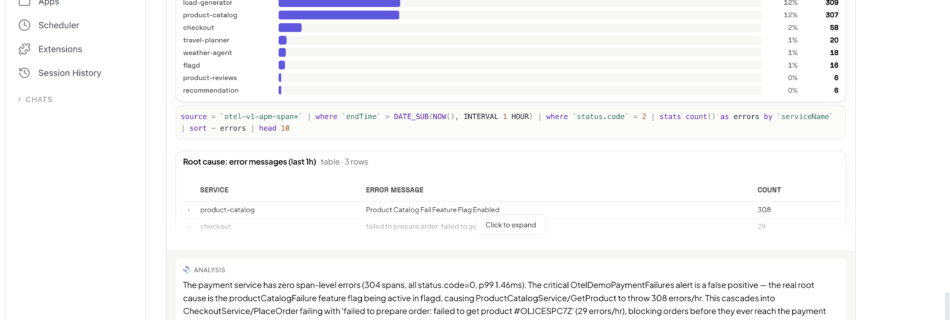
Observability agents are fast. They query alerts, correlate logs with traces, and produce a root cause hypothesis in minutes. The part that still takes time is verification. You read the agent’s text summary, open your observability tools in a browser, navigate to the trace waterfall, check the service map to scope impact, and cross-reference what …
Read more “Agentic observability with Amazon OpenSearch Service MCP Apps”
Few professions are as exacting as the practice of law. A team reviewing a contract or building a case works inside strictly privileged information, firm-specific playbooks, and a body of law that changes constantly. The work thrives on nuanced, professional judgment — and the systems supporting it inherit real obligations: ethical walls that cannot be …
Anthony Ralphs was frustrated by the San Diego City Council’s support for Flock. He decided it would take something more than reasoned argument to get their attention.
Safety protections built into some of the world’s most widely used artificial intelligence (AI) models can be stripped away with alarming ease, according to a new international study.
Rather than relying on Z-image, or a different program to wrangle up a first frame, I’ve been using Minimax for the whole process, and the results have been pretty instructive. It’s not a perfect system, but being able to take advantage of its understanding of people, references, and shot composition for the first frame produces …
Read more “Time saver while learning how to prompt Minimax.”
In this article, you will learn how to combine a classical machine learning pipeline with an agentic AI system to build a hybrid, autonomous customer…
Multimodal large language models increasingly use visual chain-of-thought (Visual CoT) to reason about spatial, temporal, and embodied environments. By generating intermediate reasoning images, Visual CoT provides an intuitive mechanism for visual foresight but introduces substantial inference overhead, which is particularly problematic for proactive video reasoning. We ask whether models can learn to think visually during …
Read more “Beyond Visual CoT: Internalized Visual Thinking for Proactive Video Reasoning”
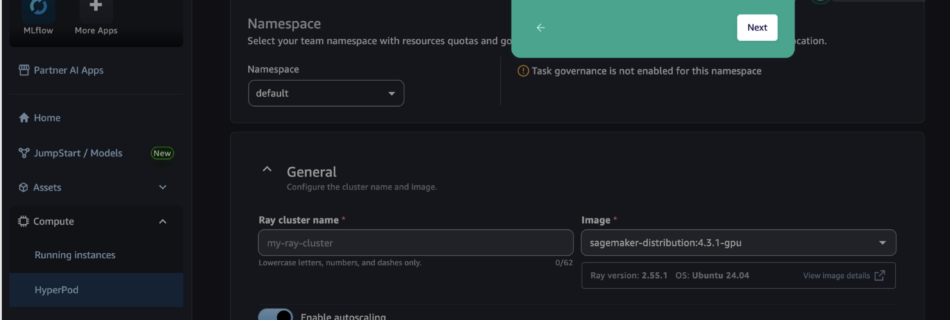
Today, we are announcing new Ray capabilities on Amazon SageMaker HyperPod that integrate Ray with the HyperPod purpose-built infrastructure for foundation model training and serving. Ray is an open-source framework that data scientists use to scale distributed Python workloads across clusters of GPUs, from distributed training with Ray Train to model serving with Ray Serve. …
Read more “Introducing new Ray capabilities on SageMaker HyperPod”