It Looks Like Nothing Can Dent MAGA’s Support for ICE
Despite weeks of renewed press coverage and controversy around ICE, Donald Trump’s supporters appear to be standing by the agency no matter what.
Despite weeks of renewed press coverage and controversy around ICE, Donald Trump’s supporters appear to be standing by the agency no matter what.
KAIST researchers have developed a safety verification technology that uncovers roughly seven times more hidden vulnerabilities in AI than existing methods. The technology is expected to serve as a foundation for developing safer, more trustworthy AI. The work is published on the arXiv preprint server.
Increasing the adoption of generative AI across the enterprise requires you to do more than deploy a generic chatbot with a custom wrapper. Interacting with business-critical databases demands absolute trust, strict governance, and deep grounding in enterprise semantics. Over the last year, Conversational Analytics (CA) in Google Cloud has moved from isolated experiments to scaled, …
Read more “Bringing Conversational Analytics to your entire data ecosystem”
In a new disclosure, OpenAI says its agent used exposed logins to gain access to at least four “publicly available services” in its unhinged quest to solve a test.
The capabilities of large AI systems are constantly improving, but they consume a great deal of energy during training and operation. The human brain, by contrast, is extremely energy-efficient: It requires only around 20 watts.
Memory & State For AI Agents Building an AI agent can be tricky. Keeping it on track over a six-month deployment is incredibly hard. LLMs…
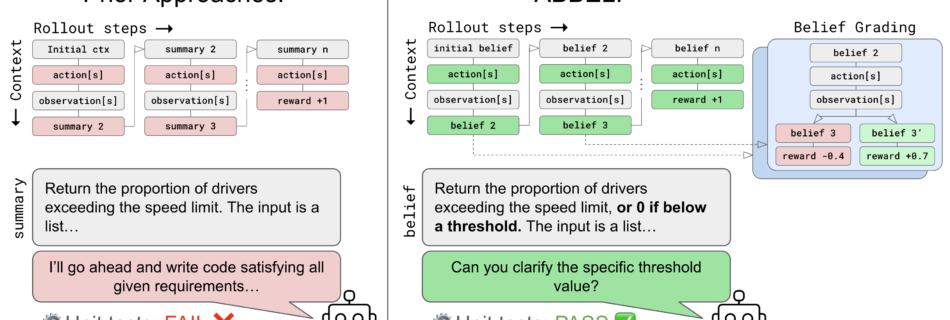
Overview of ABBEL compared to traditional recursive summarization. Beliefs replace the full interaction history as the agent’s working context, and belief grading improves performance by supervising the contents of each belief state.. As task horizons grow, LLM contexts can’t scale forever. Self-summarization enables concise, interpretable contexts, but at a significant performance cost, especially for human …
Read more “Teaching LLMs to Update Beliefs for Efficient Long-Horizon Interaction”
Systematic failures of vision models on semantically coherent subsets, known as error slices, reveal limitations in robustness and evaluation. Existing slice discovery approaches largely model slices as clusters in representation space or combinations of predefined attributes. While effective for image-level classification, such formulations are insufficient for instance-level tasks such as object detection and segmentation, where …
Read more “GH-ESD: Grounded Hypothesis-Driven Error Slice Discovery for Instance-Level Vision Tasks”

Use of third party AI model services poses significant risk to your alpha. Without sovereign control over how your data is processed by those services (either the AI Labs or the Hyperscalers, collectively referred to as “Hosted Model Providers”), Hosted Model Providers may extract your alpha (your unique institutional knowledge and tradecraft embodied in data …
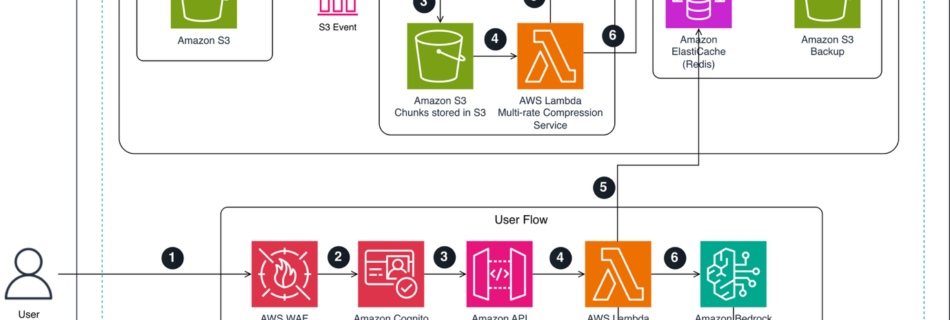
If you’re using Retrieval-Augmented Generation (RAG) for complex analytical tasks that span hundreds of documents, such as financial due diligence or regulatory compliance reviews, you’ve likely hit its ceiling. Similarity search surfaces relevant fragments but often misses cross-document connections. This post shows you how to address that gap using task-aware knowledge compression (TAKC), a technique …
Read more “Beyond RAG: Task-aware knowledge compression for enterprise AI on AWS”