1 GKE Blog Image1.max 1000x1000 1

Priority-based scheduling between node pools

Google Kubernetes Engine (GKE) is a leading managed Kubernetes service in the market. GKE is used by several organizations today that are using Google Cloud. As costs rise, customers are shifting their focus to cloud cost optimization. They are seeking more efficient and cost-effective ways to run their workloads by utilizing the best-in-class optimization techniques …

K-Nearest Neighbors Classification Using OpenCV

The OpenCV library comes with a module that implements the k-Nearest Neighbors algorithm for machine learning applications.  In this tutorial, you are going to learn how to apply OpenCV’s k-Nearest Neighbors algorithm for the task of classifying handwritten digits. After completing this tutorial, you will know: Several of the most important characteristics of the k-Nearest …

hero 1

Best of both worlds: Achieving scalability and quality in text clustering

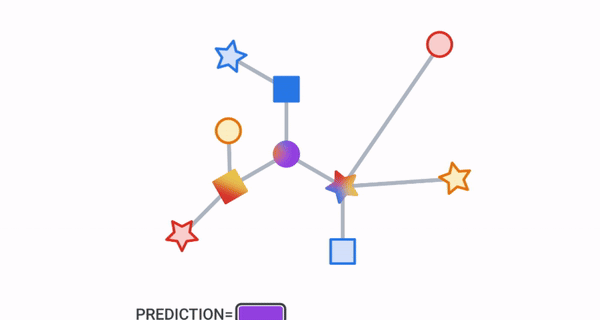
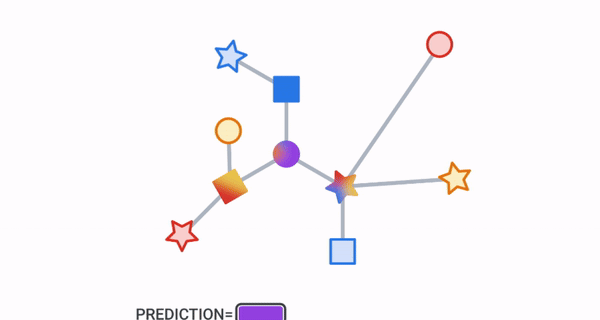
Posted by Sara Ahmadian and Mehran Kazemi, Research Scientists, Google Research Clustering is a fundamental, ubiquitous problem in data mining and unsupervised machine learning, where the goal is to group together similar items. The standard forms of clustering are metric clustering and graph clustering. In metric clustering, a given metric space defines distances between data …

12AVxZlXPDb8 d7Xf4kfSulnw

Streaming SQL in Data Mesh

Democratizing Stream Processing @ Netflix By Guil Pires, Mark Cho, Mingliang Liu, Sujay Jain Data powers much of what we do at Netflix. On the Data Platform team, we build the infrastructure used across the company to process data at scale. In our last blog post, we introduced “Data Mesh” — A Data Movement and Processing Platform. When a user …

Apache Kafka and Apache Flink: An open-source match made in heaven

In the age of constant digital transformation, organizations should strategize ways to increase their pace of business to keep up with — and ideally surpass — their competition. Customers are moving quickly, and it is becoming difficult to keep up with their dynamic demands. As a result, I see access to real-time data as a …