AI can speed design of health software
Artificial intelligence helped clinicians to accelerate the design of diabetes prevention software, a new study finds.
Artificial intelligence helped clinicians to accelerate the design of diabetes prevention software, a new study finds.
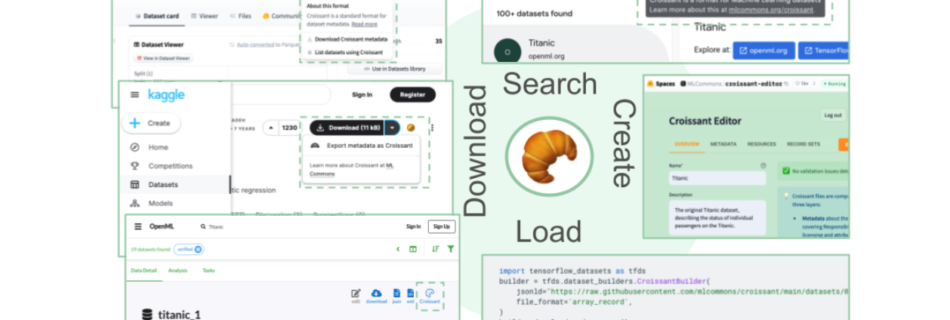
Posted by Omar Benjelloun, Software Engineer, Google Research, and Peter Mattson, Software Engineer, Google Core ML and President, MLCommons Association Machine learning (ML) practitioners looking to reuse existing datasets to train an ML model often spend a lot of time understanding the data, making sense of its organization, or figuring out what subset to use …
Read more “Croissant: a metadata format for ML-ready datasets”
Software development is one arena where we are already seeing significant impacts from generative AI tools. The benefits are many, and significant productivity gains are currently available to enterprises that embrace these tools. A McKinsey study claims that software developers can complete coding tasks up to twice as fast with generative AI. The consulting firm’s …
Read more “9 ways developer productivity is boosted by generative AI”
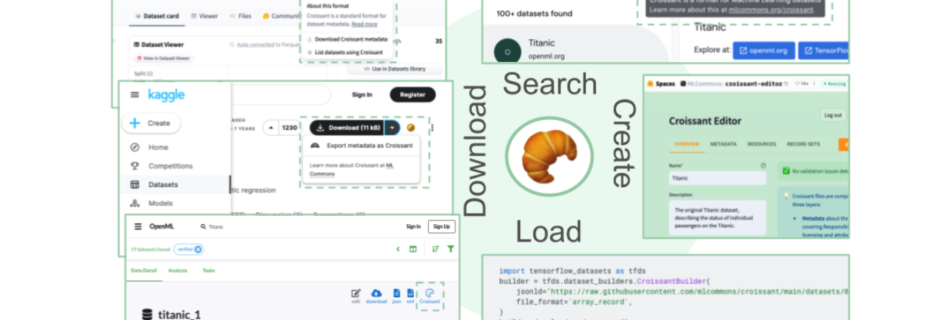
Posted by Omar Benjelloun, Software Engineer, Google Research, and Peter Mattson, Software Engineer, Google Core ML and President, MLCommons Association Machine learning (ML) practitioners looking to reuse existing datasets to train an ML model often spend a lot of time understanding the data, making sense of its organization, or figuring out what subset to use …
Read more “Croissant: a metadata format for ML-ready datasets”

In this post, we demonstrate how to efficiently fine-tune a state-of-the-art protein language model (pLM) to predict protein subcellular localization using Amazon SageMaker. Proteins are the molecular machines of the body, responsible for everything from moving your muscles to responding to infections. Despite this variety, all proteins are made of repeating chains of molecules called …
Read more “Efficiently fine-tune the ESM-2 protein language model with Amazon SageMaker”

Kubernetes is a popular way to run AI workloads like training, and large language model (LLM) serving, including our new open model Gemma. Google Kubernetes Engine (GKE) in Autopilot mode provides a fully managed Kubernetes platform that offers the power and flexibility of Kubernetes but without the need to worry about compute nodes, so you …
Paper abstract: Large-scale web-crawled datasets are fundamental for the success of pre-training vision-language models, such as CLIP. However, the inherent noise and potential irrelevance of web-crawled AltTexts pose challenges in achieving precise image-text alignment. Existing methods utilizing large language models (LLMs) for caption rewriting have shown promise on small, curated datasets like CC3M and CC12M. …
Read more “VeCLIP: Improving CLIP Training via Visual-enriched Captions”
We are dedicated to the OpenAI mission and have pursued it every step of the way.
The surprising and not so surprising benefits of generations in the Z Garbage Collector. By Danny Thomas, JVM Ecosystem Team The latest long term support release of the JDK delivers generational support for the Z Garbage Collector. More than half of our critical streaming video services are now running on JDK 21 with Generational ZGC, …
Read more “Bending pause times to your will with Generational ZGC”

In 2023, the spotlight was on generative AI (gen AI) and how it is paving the way for a new category of AI that can create and co-innovate with humans to produce new content, such as text, code, images, and music. Gen AI capabilities are not only promising but extremely powerful, given that large language …
Read more “Confluent brings real-time capabilities to Google Cloud generative AI”