Treating Prompt Templates as Hyperparameters in Scikit-LLM GridSearchCV
In this article, you will learn how to treat prompt templates as tunable hyperparameters for a language model, using scikit-learn’s grid search to find the…
In this article, you will learn how to treat prompt templates as tunable hyperparameters for a language model, using scikit-learn’s grid search to find the…
In this article, you will learn what voice agents are, how they differ from text-based AI systems, and how to build your knowledge from the…
In this article, you will learn how to fine-tune an agentic AI system holistically, covering all four critical dials: training data, parameter-efficient fine-tuning, runtime hyperparameters,…
In this article, you will learn what model distillation is, how it has evolved for large language models, and why it has become one of…
A central goal of autonomous reinforcement learning is continuous policy training without external resets. However, existing paradigms largely depend on underlying environmental reversibility, a property absent in real world manipulation, where events such as pushing objects off tables or spilling granular substances cannot be undone. We introduce REVERSAL-BENCH, a benchmark that controls reversibility via a …
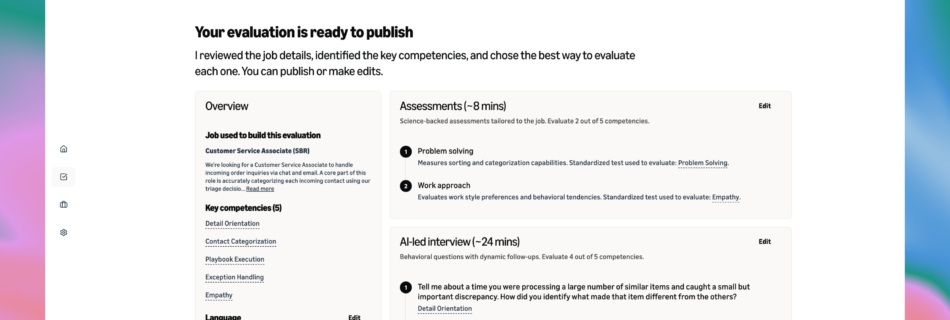
Hiring at scale in industries such as retail, logistics, hospitality, and others has its fair share of challenges. Recruiting teams are expected to fill hundreds of roles within tight timelines, often with limited capacity and with tools that weren’t designed to seamlessly work together. As a result of this, applications pile up, phone screens get …
Read more “Reduce time-to-hire for quality candidates with AI-powered Amazon Connect Talent”
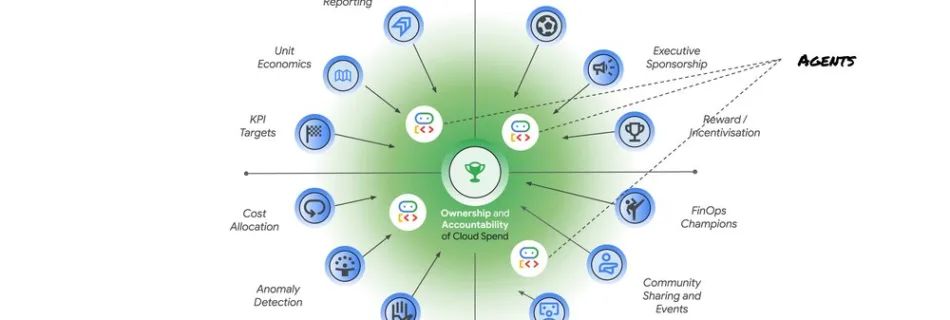
At Orange, the leading France-based multinational telecom provider, there are days when engineering teams set aside their delivery backlogs and spend the day cleaning up cloud spend together. There’s a leaderboard. There are goodies on the line. Experienced practitioners guide the newcomers, so people learn the work while doing it. By the end of the …
Read more “How Orange built FinOps accountability, and why agents are next”
This week on “Uncanny Valley,” we discuss three possible AI doomsday scenarios, AI safety, and the unexpected bipartisan alliance forming against AI.
Artificial intelligence has gradually made its way into many areas of life with abilities that often match or surpass those of humans. But a study published in the journal iScience finds that AI-powered machines have trouble recognizing objects from their overall shapes when aspects of an image are distorted. The findings offer a new way …
Read more “AI still isn’t as good at recognizing objects as people are, new test shows”
First, in Minimax, I use a prompt like this: “The character remains completely frozen in place, perfectly still like a statue. The camera smoothly orbits 360 degrees around the character in one continuous shot. No character movement, no pose change, no cuts.” Then I use COLMAP: Create a new database and import the frames extracted …