ParaRNN: Unlocking Parallel Training of Nonlinear RNNs for Large Language Models

Recurrent Neural Networks (RNNs) laid the foundation for sequence modeling, but their intrinsic sequential nature restricts parallel computation, creating a fundamental barrier to scaling. This has led to the dominance of parallelizable architectures like Transformers and, more recently, State Space Models (SSMs). While SSMs achieve efficient parallelization through structured linear recurrences, this linearity constraint limits …

ML 198324

Advanced fine-tuning techniques for multi-agent orchestration: Patterns from Amazon at scale

Our work with large enterprise customers and Amazon teams has revealed that high stakes use cases continue to benefit significantly from advanced large language model (LLM) fine-tuning and post-training techniques. In this post, we show you how fine-tuning enabled a 33% reduction in dangerous medication errors (Amazon Pharmacy), engineering 80% human effort reduction (Amazon Global …

Tom Currymax 1000x1000 1

Cloud CISO Perspectives: Practical guidance on building with SAIF

Welcome to the first Cloud CISO Perspectives for January 2026. Today, Tom Curry and Anton Chuvakin, from Google Cloud’s Office of the CISO, share our new report on using Google’s Secure AI Framework with Google Cloud capabilities and services to build boldly and responsibly with AI. As with all Cloud CISO Perspectives, the contents of …

ML 19565 diagram 1png

How the Amazon AMET Payments team accelerates test case generation with Strands Agents

At Amazon.ae, we serve approximately 10 million customers monthly across five countries in the Middle East and North Africa region—United Arab Emirates (UAE), Saudi Arabia, Egypt, Türkiye, and South Africa. Our AMET (Africa, Middle East, and Türkiye) Payments team manages payment selections, transactions, experiences, and affordability features across these diverse countries, publishing on average five …

Introducing BigQuery managed and SQL-native inference for open models

BigQuery provides access to a variety of LLMs for text and embedding generation, including Google’s Gemini models, Google-managed models from partners like Anthropic and Mistral. Using Gemini models and Google-managed partner models in BigQuery is simple — just create the model with the foundation model name and run inference directly in SQL queries. Today, we …

image ML195901

How AutoScout24 built a Bot Factory to standardize AI agent development with Amazon Bedrock

AutoScout24 is Europe’s leading automotive marketplace platform that connects buyers and sellers of new and used cars, motorcycles, and commercial vehicles across several European countries. Their long-term vision is to build a Bot Factory, a centralized framework for creating and deploying artificial intelligence (AI) agents that can perform tasks and make decisions within workflows, to …

Companion image panw blogmax 1000x1000 1

Palo Alto Networks automates customer intelligence document creation with agentic design

For a global cybersecurity leader like Palo Alto Networks, a comprehensive understanding of each customer is critical for success. For every engagement the Palo Alto Networks pre-sales team has, the comprehensive understanding is centralized in an internal Document of Record (DOR), a vital asset that provides a 360-degree standardized view of the customer for sales …

badgephotoscorp amazon 100x133 1

Securing Amazon Bedrock cross-Region inference: Geographic and global

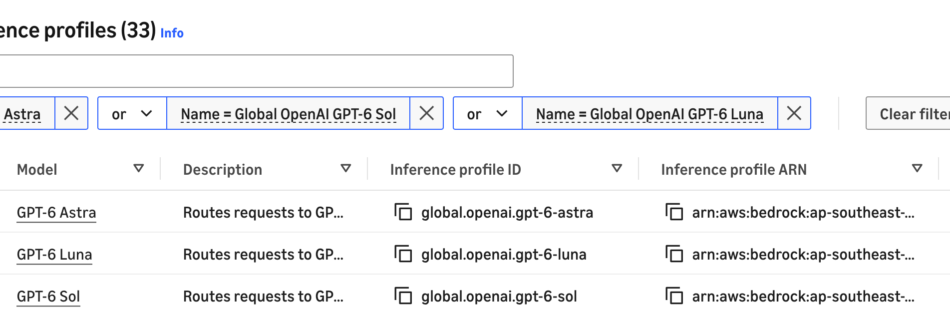
The adoption and implementation of generative AI inference has increased with organizations building more operational workloads that use AI capabilities in production at scale. To help customers achieve the scale of their generative AI applications, Amazon Bedrock offers cross-Region inference (CRIS) profiles, a powerful feature organizations can use to seamlessly distribute inference processing across multiple …

A gRPC transport for the Model Context Protocol

AI agents are moving from test environments to the core of enterprise operations, where they must interact reliably with external tools and systems to execute complex, multi-step goals. The Model Context Protocol (MCP) is the standard that makes this agent to tool communication possible. In fact, just last month we announced the release of fully-managed, …