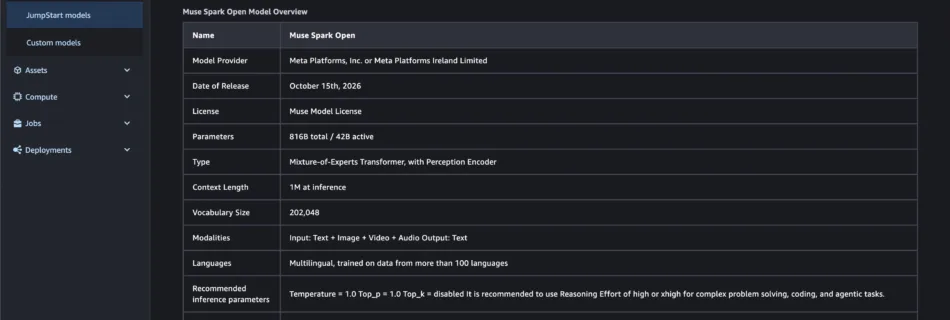
Meta’s Muse Spark Open now available in Amazon SageMaker JumpStart
Muse Spark Open, Meta’s coding-optimized open-weight model, is now available in Amazon SageMaker JumpStart, the machine learning (ML) hub of Amazon SageMaker AI. The model was trained on real developer workflows, such as multi-file refactors and long debugging sessions, and it supports a context window of 1 million tokens. You can deploy it to a …
Read more “Meta’s Muse Spark Open now available in Amazon SageMaker JumpStart”
What the Gemini agent means for startups
Small teams, short runway, and constant pressure to ship faster — it’s the reality we see every day among the founders we work with at Google for Startups. When you are building a company from the ground up, every hour spent on operational overhead or infrastructure plumbing is an hour taken away from your core …
The Design Space of Tri-Modal Masked Diffusion Models
Discrete diffusion models have emerged as strong alternatives to autoregressive language models, with recent work initializing and finetuning a base unimodal model for bi-modal generation. Diverging from previous approaches, we introduce the first tri-modal Masked Diffusion Models (MDM) pretrained from scratch on text, image-text, and audio-text data. We systematically analyze multimodal scaling laws, modality mixing …
Read more “The Design Space of Tri-Modal Masked Diffusion Models”
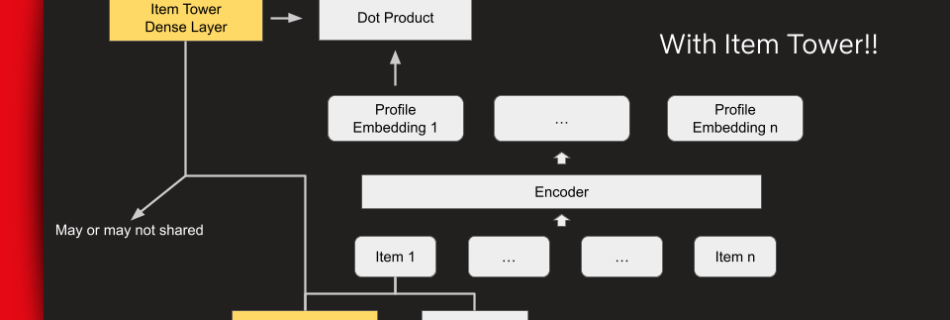
Integrating Netflix’s Foundation Model into Personalization applications
Authors: Divya Gadde, Ko-Jen Hsiao, Dhaval Patel and Moumita Bhattacharya The motivation for building the Netflix Foundation Model for personalization was laid out in this previous blog post. The Netflix homepage is powered by several specialized models and it requires significant time and resources to maintain and continue innovating on these individual models. Therefore, we …
Read more “Integrating Netflix’s Foundation Model into Personalization applications”
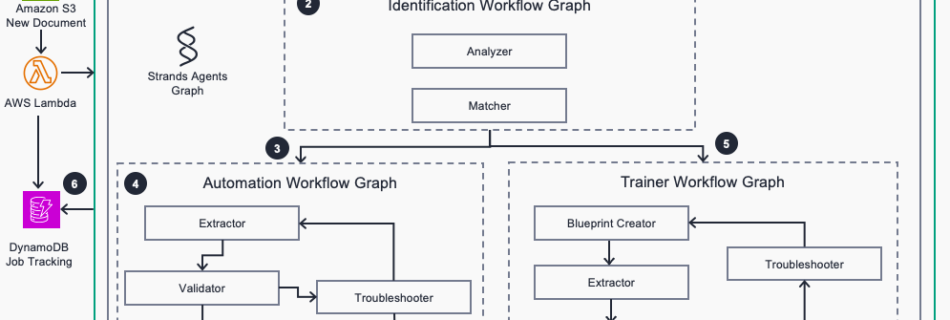
Build self-improving document processing using Amazon Bedrock AgentCore
IDC research shows that document-related challenges cost organizations $19,732 for each information worker annually and reduce productivity by 21.3 percent. Organizations receiving invoices from hundreds of suppliers often face layouts that vary by issuer and change without notice. Template-based systems require constant maintenance at this scale. Staff can spend up to 30 percent of their …
Read more “Build self-improving document processing using Amazon Bedrock AgentCore”
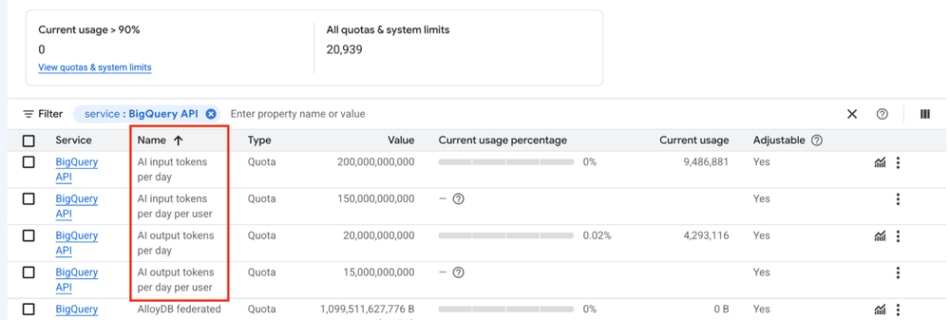
Predictable AI spend in BigQuery: Introducing cost management for generative AI functions
The generative AI functions in BigQuery (AI.GENERATE, AI.IF, AI.CLASSIFY, AI.SCORE, and more) bring large language models (LLMs) directly into your SQL, so a single query can classify millions of support tickets or score each product review for sentiment. However, because these functions are billed by the token, scaling them across massive datasets highlights the importance …
Mix, Don’t Tune: Bilingual Pre-Training Outperforms Hyperparameter Search in Data-Constrained Settings
For most languages of the world, language model pre-training operates in a data-constrained regime where models must repeat their training data many times, degrading generalization. Two remedies exist: aggressive hyperparameter tuning such as high weight decay, and mixing in data from a high-resource auxiliary language to directly aid the low-resource target. While hyperparameter tuning regularizes …
Building agents that transact with Anchor Browser and AgentCore payments
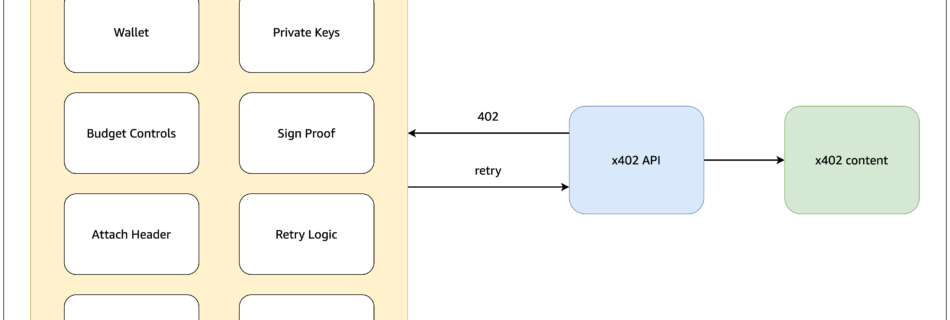
AI agents increasingly need to access web resources that are priced per request. For example, premium datasets charge by the query, research APIs meter by the call, and paywalled publishers gate content behind payment. When an AI agent encounters one of these resources, the server returns HTTP 402 Payment Required. The agent has no built-in …
Read more “Building agents that transact with Anchor Browser and AgentCore payments”
Gemini 4 Argon available on Google Cloud, built to help solve your business’ hardest problems
Last week we announced that Gemini Enterprise has evolved to make it even simpler to get work done, and introduced the Gemini agent, your new universal agent for work. It’s always on and ready to answer your questions. It will write code, complete longer and more complex tasks, or perform whatever you need to get …